

Law in the Library: Feb 8th Registration
Winnipeg Public Library has opened the registration for the Feb 8th presentation. For more information, CLICK HERE.

Repost: Immigration Reform: Low Hanging Fruit
There is no doubt that our current government has been busy since November 4th and, as an immigration lawyer, the change in rhetoric (and action!) has been like a zephyr warming up the winter blues. I still have clients mention to me that they saw the Prime Minister at the airport greetings refugees. (In photos, not live. He did not grace the Winnipeg airport with his presence.) Well done, PMJT! And now Minister John McCallum announced that they will be looking to change the loan repayment rules for refugees so that they are fair. Another move in the right direction.

Courtesy of Pexels.com
The above actions should not be trivialized and there are certainly positive changes to come. At some point, however, Minister McCallum and the government need to turn its collective mind to legislative immigration reform. There are many sections of the Immigration and Refugee Protection Act (IRPA), its Regulations and the Citizenship Act that simply need to be amended or repealed. Here is a list of low-hanging fruit:
- Amend or repeal the changes to the Citizenship Act (Bill C-24) which created “second-class” citizens and, in my view, is antithetical to what it means to be Canadian. Mitch Goldberg rightly pointed out that the provisions put every Canadian Jew at risk.
- Reversing the change in age of a “dependent child” in section 2 of IRPA. Previously, the definition took into account the reality that students in full-time studies over the age of 19 remain dependent upon their parents.
- Amend or repeal the Faster Removal of Foreign Criminals Act which has, in too many cases, transferred the burden of assessing whether a Permanent Resident should be allowed to stay in Canada (often with his/her family) from a tribunal that could hear testimony and properly assess the circumstances to a CBSA Officer who mostly concerned with enforcement.
- Amend or repeal the 1 year ban on filing Humanitarian & Compassionate (H&C) applications for failed refugee claimants. It has become very clear that there are significant cases where individuals may fail to meet the oft-high bar of satisfying a Member they are refugees (per sections 96 or 97 of IRPA) but, at the same time, there is significant hardship to merit a successful H&C application.
- Make the Open Spousal Work Permit permanent. After its first year, it was clearly a huge success. Many couples in Canada from benefited from the program and, in a small way, the Canadian economy has benefited. Instead of extending the “pilot program” into a second year, just make it permanent.
The list is short, with broad public support, so it seems fitting to call it “low hanging fruit”. I believe Minister McCallum was on the Standing Committee that considered Bill C-24 so he is well-acquainted with the issues on that point. In addition, the above changes would mean significant immigration reform that would have a positive impact on many individuals, including Canadian citizens (who are often unaware of immigration law), Permanent Residents of Canada and other people. Minister McCallum can pick this fruit, win some advocates and muster up momentum to tackle some of the more thorny issues (off the top of my head: LMIA, EE, s.34(1)(f), DCOs, s.117(9)(d), etc.). I will leave my comments on these for future posts.
Tips for Spousal Sponsorship Appeal
We sat down with Alastair Clarke, Barrister & Solicitor, to discuss ways to win a Spousal Sponsorship Appeal. Mr. Clarke has handled many of these over the years. Hopefully, these questions and answers will help you and your family reunite in Canada.
 Q: What is the most important factor to win a Spousal Sponsorship Appeal?

A: Good question. As I learned from my mentor, Mendel Green, Q.C. (a.k.a. the Godfather of Canadian Immigration Law), the most important factor is PREPARATION. The Sponsor and the Applicant will both provide oral testimony at the tribunal. The representative of the government will be cross-examining both of them, as well as any other witnesses. The cross-examination may be thorough and they may ask questions about any aspect of the application. Credibility is frequently a big issue at the hearing. In addition to the cross-examination, the Member (ie. Judge) may also ask probing and direct questions of the Sponsor, Applicant and witnesses. In my experience, the best way to prepare for the hearing is to prepare, prepare and prepare!
The biggest difference between a successful case and a refusal is preparation.
Q: What are the most common reasons for refusal?
A: I won’t be able to discuss all the reasons that I seen applications refused but I can cover the most common reasons why Spousal Sponsorship applications are refused:
- Genuine Marriage – the CIC Officer determined, for a variety of reasons that the relationship was not real and the subsequent marriage is not genuine. This is surely the most common reason that applications are refused.
- Primary Purpose test – the CIC Officer determined that the marriage was entered into primarily for immigration purposes. This has become increasingly common and it is a common reason for refusal for Arranged Marriages.
Q: What happens at the Tribunal?
A: The hearing at the tribunal, the Immigration and Refugee Board, Immigration Appeal Division, is a hearing de novo. “Hearing de novo” is a legal term that means that the tribunal makes a new determination based on everything that has happened with the individuals right up to the time of the hearing. In other words, the tribunal is not limited to the documents that were sent to CIC the time of the application. In other cases, lawyers are restricted to rely only on evidence that has been previously submitted to the original decision-maker and we cannot submit new evidence. The fact that Spousal Sponsorship appeals are hearings de novo is a significant tool for us to win cases.
Q: What is the craziest case you have handled?
A: I have handled many “crazy” cases over the years. Back in 2007, when I was an articling student at Green & Spiegel LLP in Toronto, I helped a couple from Hungary whose Spousal Sponsorship was refused. The husband was 70 years old and his spouse was 19 years old at the time. The husband had been married many times before in Canada and he was getting back to his roots in Hungary. We called many witnesses at the IAD and the best witnesses were the parents of the spouse. They were much younger than the husband but they got along with him very well. They gave extensive testimony about how he treated her as his wife and they were fully supportive of the relationship. Despite the 51 year age difference, we won the appeal.
Sometimes the “crazy” cases seem very normal at first. Another case I handled involved a sweet couple from India. On paper, they were the perfect couple. They came from families who were very well connected and they had known of each other for many years prior to the marriage. Their wedding was a large, traditional ceremony with more than 1000 people who celebrated. They provided extensive evidence of their history and their relationship.
Q: So why was that one refused?
A: I did an investigation into the application and discovered that the bride’s sister was promised to a man from another family. At the last minute, she refused to get married and he was deeply affected. His family was very angry and they sought revenge. We discovered that his family called the Canadian Immigration Hotline and they reported that the marriage of my clients was a sham. The CIC Officer took notes and included a “poison pen letter” in the file with details.
Q: Did you win?
A: Yes, we were able to prepare our clients and they gave testimony on the situation. The IAD accepted that the “poison pen letter” was not credible and we won the appeal.
Q: What is the biggest challenge with Sponsorship Appeals?
A: One challenge is the long wait. From the time we file the Spousal Sponsorship appeal, it can take up to 18 months until we actually have our hearing at the tribunal. During these 18 months, we advise our clients to be with their spouse and/or their families. It is very important that they maintain a strong relationship right up to the date of the hearing. We work with the IAD to get a positive result as quickly as possible.
Q: Which case are you most proud of?
A: I love these appeals. Helping couples reunite in Canada is one of the best parts of my job. Over the course of the many months before a hearing, I get to know the families and the couple very well and it is a pleasure to be part of their lives.
One case that stands out is a case we won quite recently. The Sponsor is a refugee who has suffered medical issues and she is unable to birth a child. She met an old friend who had a son with a previous relationship. The Sponsor fell in love with her old friend and his son and they dreamed of having a life together in Canada. She filed the Sponsorship application but it was refused because the CIC Officer did not believe the marriage was genuine. This was a complex case and we called many witnesses. There were issues with interpretation and credibility. Part of the problems was that she had previously tried to sponsor a spouse and she admitted that it was only for immigration. In the end, we won the appeal and our client is with her son in Canada. Her husband (the Applicant) will be joining them soon.
Q: Thank you for your time!
News: 2016 Sponsor Parents Application Opened (And Closed)
UPDATED (9/Jan/2016): Congratulations to those who submitted their applications. This program has reached the limit and we are no longer taking new clients. The government has received more than 14,000 new applications and they are committed to process the first 10,000. If you are interested in this program, we expect this program will reopen in 2017. Applications should be prepared and ready to go beforehand.
Citizenship and Immigration Canada announced today that its sponsorship program of parents and grandparents opened today. They are currently accepting 5000 complete applications. We have assisted many clients sponsor parents over the years and this may be an opportunity for your family:

Image courtesy of Pexels.com
We started accepting new applications to sponsor parents and grandparents on January 4, 2016 at 8:00 a.m. Eastern Standard Time. We will accept 5,000 new and complete applications. Your application will be returned to you if it is incomplete or if the cap has been reached.
This program has been in a state of flux for the past few years. Under the previous government, the program was suspended and they were not accepting any applications. Any applications that were submitted under the old system to returned. In addition, families with pending applications had to wait many years to get a decision and they would cause significant stress for our clients.
We Help Sponsor Parents
In the past, we have had success with clients who have filed both the sponsorship application and the Super Visa for temporary status. Depending on your situation, we will discuss which is more appropriate to bring your family to Canada. If you are interested in this application, we advise that you act quickly and find a professional who can help. CIC will be accepting only 5000 applications at this time and it is uncertain when they will close the program.
Please contact our office immediately to take advantage of this opportunity and sponsor your parents or grandparents. Our fees to sponsor parents and/or grandparents are posted on our website.
Check Application Status Online
Immigration applications through Citizenship and Immigration Canada (CIC) can move very slowly depending on the processing office, the type of application and the representative. We deal with all types of applications on a daily basis to make sure our clients receive a decision as quickly as possible. The most common reason for delay is that applications are sent to the Visa Office that are incomplete. Incomplete applications will not be processed and all the documents will be returned.
After an application has been compiled, organized and properly submitted, it can be frustrating to wait while CIC processes the documents. Clients, of course, are anxious to have their applications processed. There are different ways for applicants and representatives to check the application status online:
CIC’s Online Service
Applicants can check the status of their applications online using the service provided by Citizenship and Immigration Canada. Applicants can select their application, a Work Permit for example, type in their particulars and they can see whether the ap 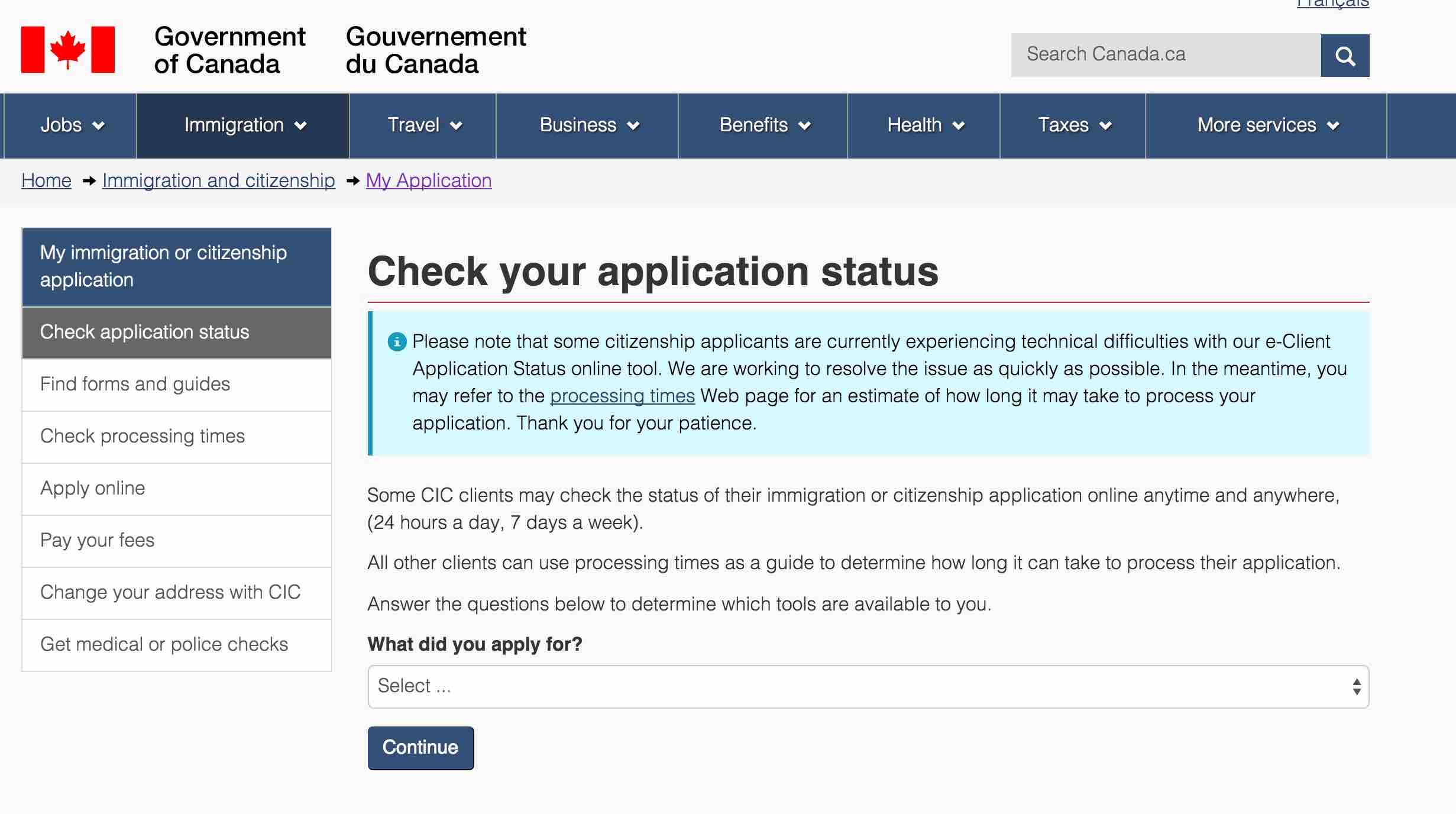 plication is in process.
Typically, we get mixed reviews from the Online Service. If an Applicant has multiple applications, the website does not clearly identify the different applications. In addition, the website provides scant detail on the progress of the application. We have had issues where a Visa Officer has sent out a letter requesting additional documentation (or, for example, updated medicals) but the Applicant failed to receive the letter. They checked online and there is no information about the Officer’s request.
CIC’s Online service is useful to confirm that the application was properly submitted and that it is in process. After that, it provides very little benefit.
CIC’s Portal for Authorized Paid Representatives
 When a lawyer prepares the application and submits the documents through the CIC Portal, the lawyer can check the status online. It provides much more information that the Online Service above. The lawyer is able to see all the documents that have been submitted and each step along the process is checked.
This is a valuable service for clients and lawyers alike.
Average Processing Times
CIC publishes the average processing times online, generally on a quarterly basis. We encourage clients to take this “average” with a grain of salt. For example, the current average processing time for an Application for Permanent Residency based on Humanitarian and Compassionate Considerations (H&C) is 30 to 42 months. There are many H&C applications currently in process.
 In our office, we assisted a single mother and her two children with an H&C application after their case made the news. We helped them file the H&C application and we were successful. They are now all Permanent Residents of Canada. The Winnipeg Free Press also covered the story after we were successful. This H&C application took approximately 14 months to process, much faster than the posted average processing times.
In another case, we assisted another family in Winnipeg with an H&C application and it was approved in less than 12 months. That said, we have contacted other immigration lawyers in Canada and we have been advised that there are currently some H&C applications that have been pending for more than 60 months.
What Can You Do After You Check Application Status?
CIC Officers and Visa Officers are individuals. They work hard and there are internal priorities within the Visa Offices. That said, after you check application status, you can contact your lawyer and ask him or her on ways to speed things up. It may be possible to work with the Officer and request expedited processing, depending on the circumstances.
If your application has been in limbo for a long time, ask your lawyer about filing a Mandamus Application with Federal Court. They have the power to ensure the CIC Officer or the Visa Officer makes a decision in a timely manner.
News: CIC Grants PR status based on Humanitarian
Clarke Immigration Law successfully represented a Polish family to obtain Permanent Resident status through a Humanitarian and Compassionate application. As noted by Winnipeg Free Press, we prepared an application with more than 500 pages of documents and legal arguments to help this family stay safe in Canada.
Published by Winnipeg Free Press on 25 Nov 2015, written by Carol Sanders.
Polish family under threat granted permanent resident status in Canada after 5 years
After five years of abuse and then the threat of having the rug pulled out from under her at any time, a single mom and her two kids from Poland can finally rest easy.
“It’s a special day for my kids and me,” Marta Placzek said Wednesday, when she and Justyna, 11, and Jakub, 8, were granted permanent resident status in Canada. They’ve been living in Winnipeg with the help of people in the Polish community and friends like Peter Morgan, who drove them to their immigration appointment on Wednesday. There, Placzek and her kids who once fled to a women’s shelter, then relied on the kindness of strangers, were granted legal status in Canada.
“I’m very, very happy,” said Placzek. “My life was very hard here,” she said. “There was much stress.”
She arrived in 2010 with her children and a new husband whom she believed had a trucking job lined up in Winnipeg. They arrived with visitors visas and when the job didn’t materialize, she alleges he began abusing her. She and the kids went to Osborne House and she obtained a restraining order that he violated. Her husband was charged by police and removed from Canada.
Placzek was desperate to stay with her kids even though their visitors visas had expired. In Poland, she had sold everything and quit her job at the railway for a fresh start in Canada. She had no family or anything to return to in Poland.
In Winnipeg, members of the community took the family under their wing. The children were allowed to attend Holy Ghost School on Selkirk Avenue for free and an immigration lawyer was hired to help her apply for permanent resident status.

Clarke Immigration Law was able to work with the community members to prepare a strong application.
Her lawyer, Alastair Clarke, asked that she be allowed to stay in Canada on humanitarian and compassionate grounds.
In a lengthy written application, Clarke outlined three main reasons. Staying was in the best interest of the children, who were doing really well in school and faced hardship if they returned to Poland, he said. There was an established history of violence with her husband. Police in Poland have a well-established reputation for not taking domestic violence cases seriously, said Clarke. If Placzek and the kids returned to Poland, the only family they’d have is a potentially violent ex-spouse, he said. In Winnipeg, the family had plenty of support, said Clarke.
People like retiree George Bibik, a volunteer interpreter, rallied the community to provide shelter and support to them. Quiet-spoken Peter Morgan, who met the family through a Polish friend, said he empathized right away with the children.
“I’m an immigrant myself,” said Morgan, who came to Canada from England when he was Justyna’s age, and had difficulty speaking. The addictions worker helps the family financially and provides them with transportation.
“I just hope they find their home here,” Morgan said. “I certainly have.”
Another factor in Placzek’s favour was her volunteering in the community, said Clarke.
“It’s purely out of the goodness of her heart,” he said.
Placzek met regularly with Victoria Lehman’s elderly mom whose first language is Polish and was showing signs of dementia. Placzek visited her in Lion’s Manor where they spoke Polish, said Lehman, who is a lawyer. Some of her clients are victims of domestic abuse, and when she saw the 2014 Free Press story about the single mom and her two kids from Poland, she reached out to help them.
“I just gravitated to that,” Lehman said.
Now that Placzek and her kids have permanent residence status, they can access provincial health care, social assistance and public schools. She’s had several job offers and can now legally obtain work and is eligible for more English language classes that she says are a priority.
Placzek wanted to stay in Canada for her children.
Jakub wants to be a lawyer when he grows up, and Justyna plans to be a veterinarian.
Placzek said she now has a better chance of realizing her own dreams, too.
“I have an idea of going to school.”
Note: Humanitarian and Compassionate cases are extremely time-consuming and generally only recommended as a last resort. Please contact a professional about whether this application is suitable to you or your family.
Clarke Law: Experienced Immigration Lawyer
Clarke Immigration Law assists clients come to Canada as Permanent Residents and as Temporary Residents. The applications for the various stream are completely different and require specific expertise. We help by providing an experienced immigration lawyer to guide you through the Canadian immigration system and give you the best chance of success.
Immigrate to Alberta
 Alastair Clarke was born and raised in Edmonton, Alberta – a vibrant city in the prairies. The city is the gateway to the north and provides services to many Temporary Workers (TFWP) on their way to Fort McMurray and the oil sands. Alberta has been booming for many years and there are many good jobs. Unemployment in Alberta is among the lowest in Canada. We provide assistance for those interested in Alberta because Mr. Clarke is an experienced immigration lawyer with the benefit of living and working in Alberta.
Immigrate to BC
Mr. Clarke moved from Alberta to British Columbia (BC) for university. He graduated with a Bachelor of Arts degree (Philosophy; Spanish) at the University of Victoria in the capital city of BC. Canada’s western-most province is the gateway to the East. There are many flights to Beijing, Shanghai, Tokyo and other metropolitan centers in Asia. While at the University of Victoria, Mr. Clarke was the Student Coordinator of the Peer Helping Program, worked with the Office of the Ombudsman on legal issues and helped International Students. These students successfully received Study Permits to study in BC. He helped these students from India, China, Nigeria, Poland and other countries in the world.
After Victoria, Mr. Clarke moved to Van couver – the largest city in BC and one of the most beautiful cities in the world. Vancouver is called “Hollywood North” because it has a thriving movie industry and TV industry. Many shows, including iZombie, Once Upon a Time and Arrow, are filmed in Vancouver and it is quite common to just stumble upon a productions crew in action.
Immigrate to Ontario
Mr. Clarke moved to Ontario and graduated just a Juris Doctor (J.D.) degree from Queen’s University in Kingston, Ontario. Kingston is a historic city on the Canadian border with one of Canada’s oldest military base and a vibrant downtown core.
In Ontario, Mr. Clarke has lived in various locations in Toronto and Kingston. Toronto is a vibrant city with a rich multicultural mosaic. On any day, you can take the subway and listen to Urdu, Cantonese, Tamil, Spanish and French. The city expands in every direction and there are distinct neighbourhoods akin to New York. Manhattan has the Tribeca; Toronto has the Entertainment District. Manhattan has Chinatown; Toronto has Little Korea.
Mr. Clarke lived in Toronto for many years and practiced immigration and refugee law at one of Canada’s top boutique law firms on Bay Street. He assisted clients from Nepal, Iran, Iraq, India, Pakistan, Israel, Russia, South Africa, the USA, China, Vietnam, Ukraine, St. Lucia, Guyana, Mexico and many other countries. He is one of Manitoba’s most experienced immigration lawyers and he can help you and your family.
Immigrate to Manitoba
In addition to Alberta, British Columbia, Ontario and Quebec, Mr. Clarke now lives in the capital city of Friendly Manitoba: Winnipeg. Winnipeg is the located at the heart of North America. It is a center for Aboriginal Culture with a vibrant arts community. Winnipeg has a spectacular historic downtown with Parisian architecture. The Exchange District is booming with chic restaurants and cafes.
Mr. Clarke’s law firm is located in Osborne Village in Winnipeg – the neighbourhood was ranked the “Greatest Neighbourhood” in Canada by CBC in 2012. Osborne Village is a community where everything is at your fingertips. Boutiques and cafes line the streets with trendy fashions and souvenirs. In the winter, Osborne Village has access to the Assiniboine River and you can skate along the river to downtown.
Manitoba is a stable, peaceful province that is perfect for professionals and families. The school system is welcoming to children from all over the world. Winnipeg’s neighbourhood of St. Boniface is French. The Louis Riel School Division is 100% in French and there is a strong community from Burundi and Congo.
Manitoba boasts 4 seasons and the ever-changing weather of the prairies. Summer is festival season and there are international activities, music and events from every culture. Folklorama is a must-see. In Fall/Autumn, the Elm Canopy – which is one of the only remaining in the world – turns from green to orange and yellow in the Fall. International Students arrive to the University of Winnipeg and the University of Manitoba on Study Permits. The international-acclaimed Museum of Human Rights is perfect for a winter day. Spring is a wonderful time in Manitoba with flowers and everything blooms.
Manitoba has a strong economy boosted by the Canadian Mint, the International Centre for Infectious Diseases, the Museum of Human Rights, the Winnipeg Art Gallery, the pork Industry and many other cutting-edge businesses.
Retain an Experienced Immigration Lawyer
Mr. Clarke has lived in 5 of Canada’s 10 provinces so there are still more places to explore. Eastern Canada, including the provinces on the Atlantic Ocean are also vibrant with their own unique culture. Sask has a booming economy with the Potash Industry and there are many jobs. Mr. Clarke has assisted many clients who live in Sask and assists as an experienced immigration lawyer.
Immigration to Canada can be one of the best changes in your life and the life of your family. But it can be a daunting task. Clarke Immigration Law assists individuals and businesses come to Canada – and stay in Canada. We provide an experienced Immigration Lawyer to help you through the process.
CLEA: Immigration Presentation
As part of the Law in the Library series, Alastair Clarke will be giving a free presentation to the public on May 19, 2015 at St. Vital Library. Everyone is welcome to attend.
Topics:
- Spousal Sponsorship applications
- Temporary Resident Application
- Temporary Resident Permits
- Citizenship Applications
- Dependent Children – changes to the definition in IRPA
- Manitoba Provincial Nominee Program
- And more more.
For more information, check out the CLEA Website for more details and to RSVP.
CONTACT




MEMBERSHIPS


